Feature
Tinubu, 2027 And The Burden Of Judgment

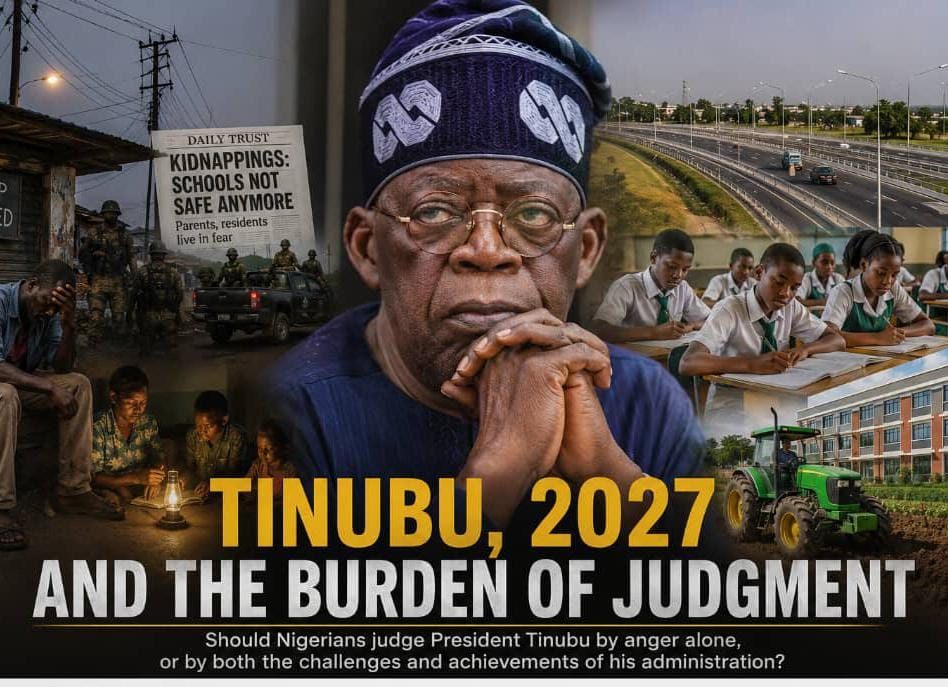
A few days ago, I came across a pamphlet distributed by the Tinubu Youth Vanguard Organisation (TYVO), listing what it described as some of the major achievements of President Bola Ahmed Tinubu’s administration within the last three years.
Ordinarily, such a pamphlet would have passed as another piece of political mobilisation. Yet, considering the growing dissatisfaction in many parts of the country and the increasing attacks on anyone identified as a supporter of the President, it raises a question that deserves serious reflection: should Nigerians judge President Tinubu solely on the basis of their present frustrations, or should his record in office also form part of the assessment? The question has become even more relevant in recent months.
On Facebook, WhatsApp, X and other social media platforms, some Nigerians have openly declared that they can no longer associate with those who still support the President. Others have gone further to suggest that any citizen who wishes to see President Tinubu return in 2027 must either be benefiting from government or be indifferent to the hardship facing ordinary people. The frustration behind such reactions is not difficult to understand.
Across the country, insecurity remains a major concern. Reports of kidnappings continue to emerge from different states. The recent abduction of school children, teachers and school administrators in Oyo State has once again drawn attention to the vulnerability of schools and rural communities. Many Nigerians have also expressed disappointment over what they consider a slow or inadequate response from the authorities whenever such incidents occur.
Electricity supply remains another sore point. Businesses spend huge amounts on alternative power sources. Families struggle with rising energy costs. Many communities still experience prolonged blackouts despite repeated assurances that the power sector would witness significant improvements.
ALSO READ: Ribadu, Gbajabiamila Lead Presidential Delegation To Oyo Over School Kidnap
The economy presents its own challenges. The cost of living continues to trouble millions of households. Food prices remain high. Transportation costs have increased considerably. The purchasing power of ordinary citizens has been weakened, and many people believe government has not done enough to cushion the effects of these difficulties. These concerns are genuine and should not be dismissed or explained away.
At the same time, fairness demands that any administration be assessed not only by its shortcomings but also by the efforts it has made and the policies it has introduced.
According to the TYVO pamphlet, the Tinubu administration has recorded a number of initiatives and reforms in governance, finance, infrastructure, education, health and agriculture.
Among the programmes highlighted are the Nigerian Education Loan Fund (NELFUND), CreditCorp and the push for Local Government Autonomy. The administration also introduced the Naira for Crude policy and established the National Credit Guarantee Company.
Supporters of the government point to a reduction in the budget deficit from about 50 per cent in 2023 to approximately 25 per cent in 2025. They also cite the passage of tax reform legislation, increased government revenue, growth in non-oil exports and the attraction of foreign investment into the country.
The same report claims that Nigeria recorded over forty billion dollars in foreign investment commitments, improvements in stock market performance and a trade surplus running into trillions of naira.
Supporters further argue that the country has moved away from the era of direct monetary financing of government deficits and that states are now in a better position to meet their financial obligations, including the payment of workers’ salaries.
In the area of education and human capital development, the administration introduced the Three Million Technical Talent initiative and expanded Technical and Vocational Education and Training programmes.
The Nutrition 774 Initiative and the Renewed Hope Ward Development Programme were also listed among government interventions aimed at improving social welfare and grassroots development.
The Green Imperative Project was revived. Efforts were reportedly made to strengthen the cotton, textile and garment industry, while the cocoa sector received renewed attention through the reinstatement of a Cocoa Board.
The pamphlet also highlighted the NIPOST Agricultural Infrastructure and Logistics initiative, the Digital Learning for All programme through NITDA and the National Health Fellows Programme.
In the area of security and environmental management, forest guards were reportedly introduced across forest reserves. The administration also launched the Nigeria First Policy and the Smart Urban Planning Agenda.
Supporters further point to the establishment of six mega CNG bus terminals across regional zones and training opportunities targeted at beneficiaries across wards in the federation.
Health sector reforms were equally highlighted. These include increased investment in healthcare, implementation of the new national minimum wage and efforts aimed at strengthening medical services across the country.
Economic managers within the administration have also pointed to the reduction of certain debt obligations, the clearance of foreign exchange backlogs, efforts to stabilise the Central Bank, increased support for industries and small businesses and the establishment of six regional development commissions.
In infrastructure and economic development, supporters cite the creation of the Ministry of Livestock Development, Special Agricultural Processing Zones, the Compressed Natural Gas initiative and renewed efforts to activate domestic refining capacity.
They also point to the Lagos-Calabar Coastal Highway project, the Sokoto-Badagry Super Highway proposal, oil asset metering initiatives, measures against oil theft, mining sector reforms, maritime monitoring systems and mortgage support programmes.
Whether one agrees with all these claims or not, they form part of the record being presented by those who support the administration.
The difficulty, however, is that governments are rarely judged by policy documents, speeches or pamphlets. They are judged by the daily experiences of the people.
A trader who struggles to keep a business running because of electricity challenges may find little comfort in economic statistics. A parent worried about the safety of a child is more concerned about security than government projections. A family struggling to put food on the table naturally wants to see immediate improvements in living conditions. That is where the administration faces its greatest test.
The achievements listed by supporters may deserve recognition, but they cannot replace the urgent need to address insecurity. Nigerians want to see stronger action against kidnappers, bandits and criminal networks that continue to threaten lives and livelihoods.
Electricity supply also requires serious attention. No nation can achieve sustainable industrial growth while businesses and households remain heavily dependent on generators and alternative power sources.
The economy equally demands sustained attention. Economic reforms may be necessary, but their benefits must gradually find expression in the everyday lives of ordinary citizens. People want to feel the impact of government policies not only in official reports but in their markets, workplaces and homes.
Personally, I believe President Tinubu should be allowed to complete his constitutional tenure and, if re-elected by Nigerians, serve out a second term before handing over. Political stability remains important in any democracy. Yet support should never mean silence.
Those who support the President owe him honesty. The country cannot continue to grapple with worsening insecurity, unreliable electricity supply and economic hardship without decisive intervention from those entrusted with leadership.
The achievements highlighted by his supporters deserve consideration. They should not be dismissed simply because they come from a political organisation. At the same time, government must understand that Nigerians do not live on policy announcements. They live with realities. They measure success by what they experience daily.
Until security improves significantly, electricity becomes more reliable and the economy offers greater relief to ordinary citizens, many Nigerians will continue to ask difficult questions. When the time comes in 2027, the decision will rest with the Nigerian people.
That decision should neither be driven by anger alone nor by political loyalty alone. It should be guided by a careful assessment of what has been achieved, what remains undone and what the future demands.
Lawrence Efeturi
Assoc.CIEPUK
The Insight Pen








Oborevwori Declares Zero Tolerance For Crime, Criminality In Delta

Ogwashi-Uku Youths Begin New Chapter As Ugbah Pledges Unity, Jobs , Development

APC Ward 1/5 Women Leader, Mrs. Oyibode, Takes Grassroots Sensitisation To Uduere, Iwhreovie Communities

Oborevwori Boosts Healthcare With MRI, CT Scanners, Employs 700 Workers

Delta Police Arrest Education Commissioner, Three Others Over Deputy Director’s Death

FG Approves Ports Upgrade In Delta, Two Other States

Gov. Soludo Mourns Tragic Passing Of Schoolboy, Urges Environmental Responsibility

2026: Delta Releases JSS 3 Results As 85,049 Candidates Pass

DELSU Releases 2026/2027 UTME Cut-Off Marks, Clinical Science Tops With 77.3

BREAKING: DELSU Releases First Batch Admission List, VC Confirms

Ukwuani: Chief Fredrick Ezenwiwe Declared Missing After Going To Farm

Delta: NAPPS Day, Groundbreaking For World-Class Secretariat To Hold October 12

23-Year-Old DELSU Student Emerges King In Ekwuoma Kingdom

Otefe: Delta State Polytechnic Announces 2026/2027 Post-UTME Screening Dates


-
 News10 hours ago
Oborevwori Boosts Healthcare With MRI, CT Scanners, Employs 700 Workers
-
News6 hours ago
Ogwashi-Uku Youths Begin New Chapter As Ugbah Pledges Unity, Jobs , Development
-
Events7 hours ago
APC Ward 1/5 Women Leader, Mrs. Oyibode, Takes Grassroots Sensitisation To Uduere, Iwhreovie Communities
-
News33 minutes ago
Oborevwori Declares Zero Tolerance For Crime, Criminality In Delta