
News
Guardians Of The Machine: Global Experts Converge As NAAIP Outlines Ethical Roadmap For Nigeria’s AI Revolution

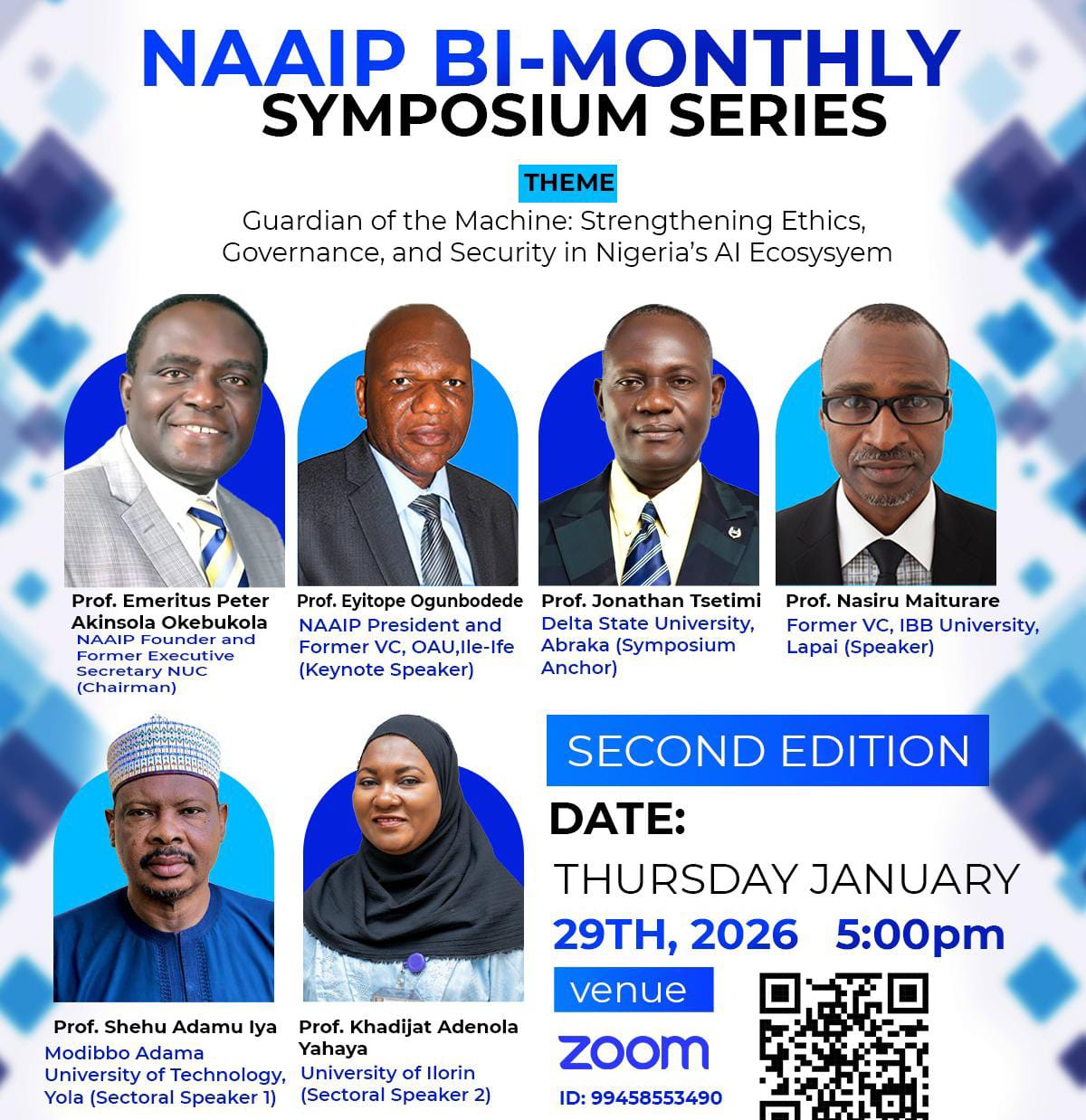
ABUJA, NIGERIA — In a high-level virtual summit that signaled a turning point for Africa’s most populous nation, the National Association of Artificial Intelligence Practitioners (NAAIP) held its second bi-monthly symposium on Thursday, January 29, 2026. Under the theme “Guardian of the Machine: Strengthening Ethics, Governance, and Security in Nigeria’s AI Ecosystem,” the event drew a global audience from the USA, Kenya, Uganda, and Zambia, together with diverse audience across the country, uniting world-class scholars and industry titans in a bid to secure Nigeria’s digital future.
The virtual room for the symposium opened at about 4.30pm with the General Secretary of NAAIP, Dr Kehinde Abiola, welcoming dignitaries. The symposium was formally opened by Professor Nasiru Maiturare, with a resonant call to order that preceded an address by the Chairman and Founder of NAAIP, Professor Emeritus Peter Akinsola Okebukola, OFR. Professor Okebukola’s opening address set the tone for the business of the day. He commended NAAIP executives for the choice of the theme which is very timely in the light of the current realities in Nigeria’s AI ecosystem. The symposium anchor Professor Jonathan Tsetimi, NAAIP Vice-President South-South, and Director Centre for International Collaboration and Linkages, DELSU, Abraka, provided the mandate for the session, emphasizing that as AI permeates every facet of Nigerian life—from fintech and healthcare to agriculture and religious expression—the nation must move beyond mere adoption to active stewardship of the technology’s moral and security foundations.
The Ethical Imperative: “Who Guards the Values?” Delivering a compelling keynote titled “Trust by Design: Building an Ethical Foundation for Nigeria’s AI Future,” Professor Eyitope Ogunbodede, former Vice-Chancellor of Obafemi Awolowo University and President of NAAIP, challenged the audience with a profound question: “Who guards the values behind the machine?”. Professor Ogunbodede asserted that AI is not a neutral tool but a reflection of its designers’ values and the data used to train it.
ALSO READ: Awhefeada Explores Link Between Literature, Medicine At DELSU Inaugural Lecture
He warned that for a nation as diverse as Nigeria, with over 250 ethnic groups, skewed or foreign-imported datasets risk creating an “invisible” majority or reinforcing historical marginalization. To prevent this, he outlined five ethical pillars: human-centeredness; fairness and inclusion; transparency; accountability; and security. “Every line of code written,” he declared, “is a moral choice”.
Securing the Frontier Against “Intelligent” Adversaries The technical discourse took a sobering turn with Professor Shehu Adamu Iya of Modibbo Adama University, who discussed “Securing the Digital Frontier”. Professor Iya warned of a “paradigm shift” where Nigeria is no longer defending against human hackers but against “intelligent, adaptive systems” capable of autonomous learning and industrial-scale misinformation.
His presentation highlighted the vulnerability of national critical infrastructure—such as energy grids and water treatment plants—to AI that can learn operational patterns to maximize physical destruction. To counter this, he advocated for “Defensive AI” that probes for weaknesses 24/7 and the adoption of digital provenance standards, such as the Coalition for Content Provenance and Authenticity (C2PA), to restore public trust in the face of deepfakes.
From Policy to Policing: Bridging the Regulatory Gap Professor Khadijat Adenola Yahaya rounded out the expert sessions by addressing the role of governance in AI accountability. While noting that the Nigeria Data Protection Act (NDPA) 2023 serves as a “legislative backbone,” she pointed out critical gaps in enforcement capacity and a fragmented regulatory landscape.
Professor Yahaya emphasized that effective governance must move from “policy intention” to “policy enforcement,” calling for the establishment of dedicated oversight units and the use of regular risk-based audits for AI startups. She noted that the draft AI Code of Practice (2025) is a step in the right direction but stressed that human oversight of automated decisions must remain a non-negotiable standard.
The event concluded with an interactive Q&A session where participants lauded the organizers for tackling the “implementation gaps” of the National AI Strategy. In his closing remarks the chairman of the event, Professor Emeritus Peter Akinsola Okebukola, commended the executive committee of NAAIP for the timely discourse and advised them not to rest in their oars in promoting responsible use of AI for national development. The symposium ended at about 6.15 pm after a vote of thanks by Professor Aleruchi Chuku. In her vote of thanks, Professor Aleruchi Chuku lauded the speakers for their excellent delivery and the participants for creating time to attend this very important symposium, she also reiterated NAAIP’s commitment to serving as the “conscience” of Nigeria’s AI ecosystem, ensuring that technological advancement never comes at the cost of human dignity.
COMMUNIQUE OF THE SECOND NAAIP BI-MONTHLY SYMPOSIUM
Theme: Guardian of the Machine: Strengthening Ethics, Governance, and Security in Nigeria’s AI Ecosystem
Date: Thursday, January 29, 2026
Venue: Virtual (Via Zoom)
1. PREAMBLE AND MANDATE
The National Association of Artificial Intelligence Practitioners (NAAIP) convened its second bi-monthly symposium on January 29, 2026. Following the inaugural session on national strategy, this edition shifted focus to the “Foundational Principles of Trust”. The symposium served as a critical platform for academics, industry leaders, and policymakers to establish the “guardrails” necessary for sustainable innovation as AI becomes deeply integrated into Nigerian finance, healthcare, and governance.
The symposium was officially called to order at 5.00 pm prompt by Professor Nasiru Maiturare, followed by an opening address from the Chairman and Founder of NAAIP, Professor Emeritus Peter Akinsola Okebukola (OFR), setting the tone for the evening. Symposium Coordinator Professor Jonathan Tsetimi introduced the mandate, emphasizing that as AI becomes deeply integrated into our lives, the nation must prioritize the foundational principles of trust to combat emerging risks like algorithmic bias and deepfakes.
2. THE ETHICAL IMPERATIVE FOR NIGERIA
Keynote Speaker Professor Eyitope Ogunbodede emphasized that AI is no longer a future prospect but a present reality in Nigeria, influencing everything from fintech and health diagnostics to cultural expressions. He argued that AI systems are never neutral; they reflect the values and biases of their creators and the data used to train them.
The symposium identified five core ethical pillars for Nigeria’s AI future:
• Human-Centeredness: Ensuring technology serves human well-being and potential.
• Fairness and Inclusion: Actively reducing bias to reflect Nigeria’s 250+ ethnic groups and avoiding digital marginalization through representative local datasets.
• Transparency: Implementing “explainability” so that AI decisions are understandable and open to scrutiny.
• Accountability: Defining clear lines of responsibility for those who design and deploy AI systems.
• Security and Resilience: Protecting against data breaches, deepfakes, and “digital colonialism”.
3. SECURING THE DIGITAL FRONTIER
Professor Shehu Adamu Iya presented a sobering analysis of AI as a “force multiplier” in cyber threats. He noted a paradigm shift where the nation is no longer defending against human hackers but against intelligent, adaptive systems capable of hyper-personalized social engineering and autonomous malware.
Critical areas identified as being “under siege” include:
• National Infrastructure: Coordinated AI attacks on energy grids, water treatment, and transportation systems.
• Financial Systems: AI-driven market manipulation and ultra-sophisticated fraud that evades traditional filters.
• Public Trust: The proliferation of industrial-scale misinformation and deepfakes designed to erode trust in democratic processes.
The symposium advocated for a “Zero-Trust Architecture” and the investment in “Defensive AI” to probe for weaknesses before adversaries do. Furthermore, the adoption of the Coalition for Content Provenance and Authenticity (C2PA) standards was recommended to verify the origin and history of digital content.
4. GOVERNANCE: FROM POLICY TO POLICING
Professor Khadijat Adenola Yahaya examined the role of governance in AI accountability, identifying the Nigeria Data Protection Act (NDPA) 2023 as the legislative backbone. While the NDPA provides enforcement powers, the symposium noted critical gaps, including limited technical expertise among regulators and a fragmented regulatory landscape.
To bridge the gap from “policy to policing,” the communique recommends:
• Translating high-level policies into clear operational guidelines for practitioners.
• Establishing dedicated enforcement and oversight units within regulatory bodies.
• Mandating Data Protection Impact Assessments (DPIAs) for high-risk AI processing.
• Strengthening human oversight to ensure that automated decisions are subject to meaningful review.
5. CALL TO ACTION AND RECOMMENDATIONS
The symposium concluded with a definitive call to action for all stakeholders:
• To Government: Set clear standards, fund R&D in defensive AI, and foster public-private partnerships.
• To Industry: Build security and provenance into AI systems by design and share real-time threat intelligence.
• To Academia: Pioneer new defensive technologies and study the long-term societal impacts of automation.
• To the Public: Demand accountability from tech providers and cultivate “critical literacy” to identify AI-generated misinformation.
NAAIP reaffirms its commitment to serving as the “conscience of Nigeria’s AI ecosystem,” ensuring that every line of code deployed in the nation is a moral choice that protects the dignity and security of all citizens.
Signed: NAAIP Executive Committee











Ahon Salutes Oghara Poly Rector, Prof. Ufuophu-Biri, On Birth Anniversary

Police Arrest Suspected Female Gunrunner In Agbor, Intercept Adulterated Beverages In Warri

Oasis Magazine Publisher Felicitates Prof. Emmanuel Ufuophu-Biri On His Birthday

Five Years Of Royal Renaissance: Delta Bureau Celebrates Ogiame Atuwatse III, Visionary Father Of The Itsekiri Nation

Engineering Innovation Key To Nigeria’s Security, Safety, Sustainable Development — Owamah

APC Set For DTHA Contest In Ethiope East, Abraka Constituencies, As Akpowowo, Erhimedafe Emerge

Oborevwori: My Govt’ll Support Farmers, Investors With Infrastructure

Eight Years After, Court Sentences Two To Death For Murder Of DELSU First-Class Student, Elozino

2026 Cognitive/Placement Examination: 112,543 Candidates Pass As 4,640 Fail In Delta

DELSU: Criminology And Security Studies Unit Decorates Agents, As VC Commends Their Resilience
DELSU Extends Non-Teaching Staff Appraisal, Post-UTME Registration To July 31

“Nigeria Will Never Be An Islamic Nation” — Pastor David Ibiyeomie Condemns Reported Move To Restrict Bus Preaching

DELSU Provost, Atonuje, Gives Daughter Out In Marriage